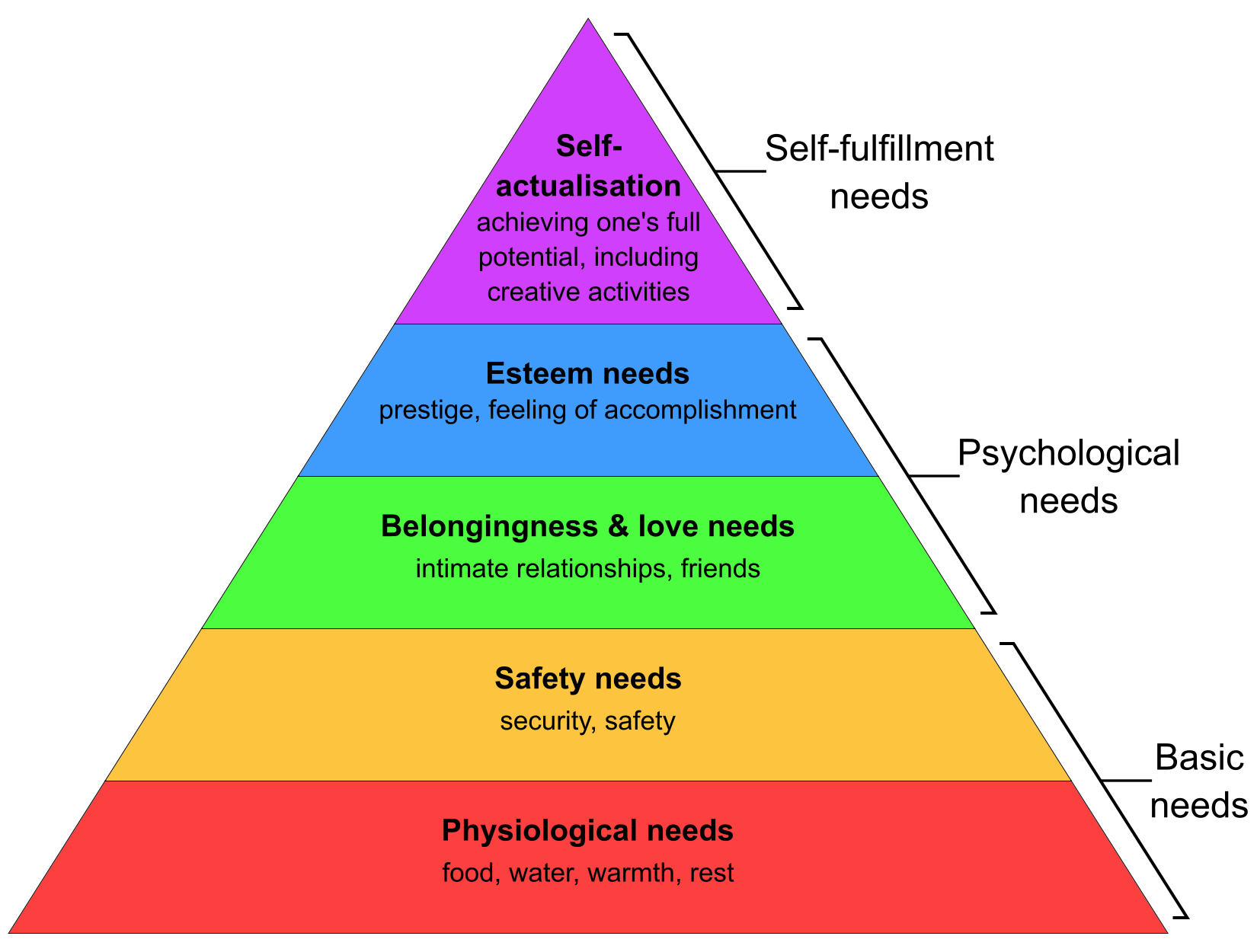
Maslow’s hierarchy of needs is meant to consist of universal human needs where lower levels of needs are more basic–the lowest being essential for survival–and form the foundation for higher levels, and ultimately the crowning concept of self-actualization. Physiological needs like food and water are essential for life. Safety needs are the next most essential. Next come belongingness, esteem, and finally self-actualization.
Edwin Shneidman’s book utilizes an adaptation of Murray’s system of needs. In Murray’s theory, needs are not hierarchical as in Maslow’s; they are instead dependent on the individual in whom certain needs may be more important than others. Shneidman adapted Murray’s needs to form a psychological need form in which needs are given a number based on importance to the individual. All numbers must add to 100. Insufficient fulfillment of some of these needs can cause psychological distress and potentially harmful behavior.
I would rank autonomy, inviolacy, and understanding high on my list of needs.
Regarding Maslow’s hierarchy, my therapist said that I seem to skip level three (love and belongingness) and go on to the higher levels. According to Maslow, lower needs must be obtained before higher needs are considered for attainment, so my therapist’s take is interesting. There are criticisms of Maslow’s hierarchy, however, such as the subjects that he studied not being representative of the entire population. Perhaps my needs for autonomy and inviolacy outweigh the need, and even the desire, for love and belonging.
Theory, in the general sense of contemplation of phenomena and possible explanations, can be interesting to ponder and consider. When people form a theory, it can be important for them to take into account their own perspectives and biases as well as whether they are indeed looking at the entire picture, i.e., if they truly have a sufficient body of facts, and consider possible outliers and possible reasons for those outliers. It can be easy to assume that one has all the relevant facts and fail to consider or even be aware of facts that may weaken or invalidate one’s theory (see inductive reasoning). Nonetheless, even if a theory isn’t 100% accurate, it can still be a useful tool for reasoning and reflection.
 Currently Untitled